FRPU
window
Pultruded FRP fiberglass window with polyurethane resin matrix. No steel liner, excellent thermal insulation, salt‑corrosion & weather resistance. Fit for passive house, coastal and high‑rise projects, customizable casement & sliding styles.。
A project schedule can look straightforward until the window and door profiles enter the discussion. A contractor may be ready to install frames in a few weeks, while a distributor is waiting to confirm a color, glazing configuration, or custom section drawing. At that point, one practical question becomes central: how long does pultruded FRPU profile production take?
The short answer is that the pultrusion process itself is continuous and comparatively fast once the production line is approved and running. The full lead time, however, is shaped by much more than line speed. Profile geometry, whether an existing mould can be used, raw-material readiness, surface requirements, production quantity, inspection standards, fabrication needs, and shipping arrangements all affect the calendar.
For buyers of fiberglass-reinforced polyurethane (FRPU or GFRPU) window and door profiles, separating manufacturing time from total project lead time makes planning far more reliable. A standard profile ordered from an established system may move through production very differently from a new thermal-break-free window frame design requiring dedicated tooling and sample confirmation.
The Key Distinction: Continuous Production vs. Complete Order Lead Time
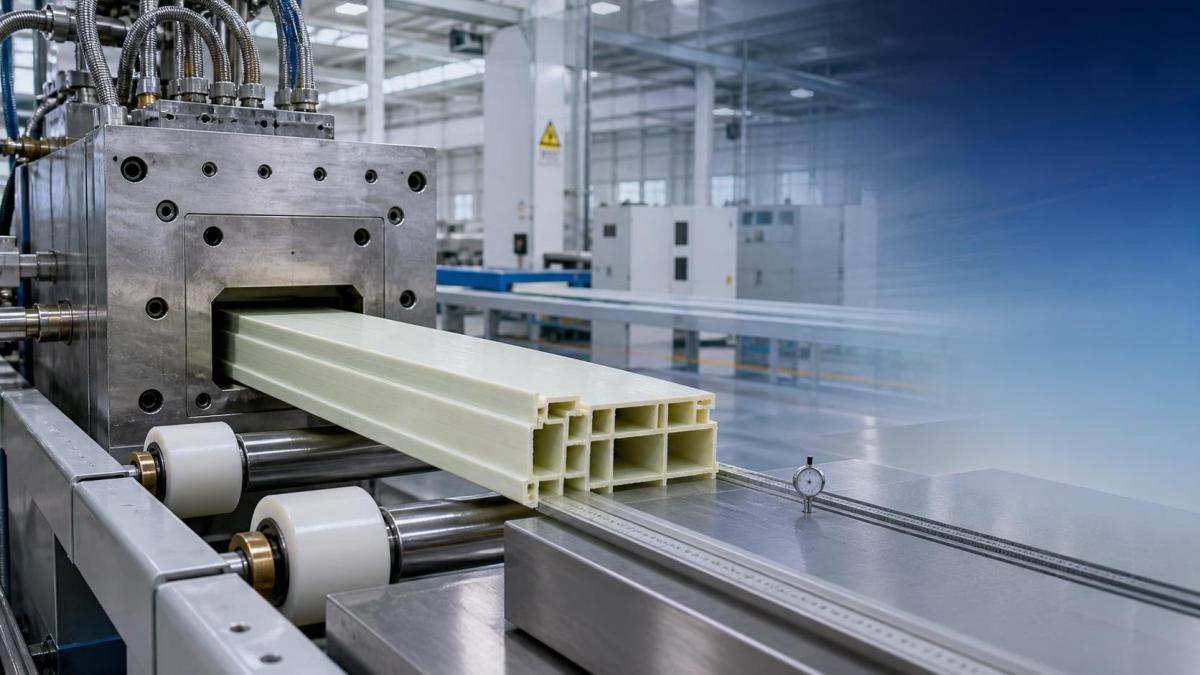
Pultrusion is not a batch process in the same sense as casting or many conventional fabrication methods. Reinforcement fibers are guided through resin impregnation, shaped in a heated steel die, cured under controlled conditions, and pulled continuously into a stable composite profile. Once parameters are set correctly, the line can produce long, consistent FRPU sections in an ongoing run.
That production rhythm can create an understandable misconception: if the line is continuous, why does a custom profile order need preparation time? Because the profile leaving the die is only one part of a deliverable window or door solution. Before the run begins, the manufacturer must confirm drawings, select reinforcement architecture, prepare the resin system, check the die condition, establish pull speed and curing parameters, and define inspection criteria. After pultrusion, profiles may require cutting, color finishing, machining, packing, or assembly into finished frames.
For planning purposes, it is useful to view an FRPU order as a sequence of decisions rather than a single factory operation.
What Happens Before the Pultrusion Line Starts?
The earliest stage often determines whether an order progresses smoothly or loses time to revisions. For standard window and door systems, the process begins with confirmation of the profile series, wall thickness, color, length, packaging method, and delivery destination. For custom work, the discussion goes deeper: chamber structure, corner connection method, screw-holding needs, glass rebate dimensions, drainage logic, hardware compatibility, thermal targets, and installation interfaces all need to be clear.
FRPU is especially valued in energy-efficient windows because it combines low thermal conductivity with useful structural performance, without the need for steel reinforcement in many profile designs. But this advantage should not encourage rushed design decisions. The fiber orientation, resin formulation, profile shape, and local reinforcement zones need to work together. A slender casement sash, a wide sliding frame, and a top-hung window profile do not experience loads in the same way.
When information arrives as a complete technical package—section drawings, tolerances, intended application, expected lengths, color specification, annual or project quantity, and relevant glass or hardware details—the manufacturer can make faster and more dependable decisions. Incomplete drawings do not always stop a project, but they often create a cycle of questions that extends the pre-production phase.
New moulds are usually the longest variable
If a suitable pultrusion die already exists, a buyer avoids the most time-sensitive development step. Where a completely new FRPU profile is required, mould design and manufacture become a separate workstream. The die must be accurate enough to form a stable section while accommodating resin flow, fiber volume, curing behavior, and expected dimensional tolerances.
This is why a new-profile inquiry should not be evaluated only by the nominal width and height of the section. A cross-section with multiple cavities, narrow walls, complex sealing grooves, or distinctive connection features may demand more design attention than a visually larger but simpler frame section. The goal is not merely to make a profile that can be pulled through a die; it is to create one that remains consistent over a production run and performs properly in a completed window or door.
How the Profile Complexity Changes Production Time
Not all pultruded FRPU profiles place the same demands on the line. A simple structural strip or rectangular reinforcement member generally has fewer variables than a multi-chamber window frame with glazing grooves, gasket retention features, drainage provisions, and interlocking sash details. Complexity does not make a project unmanageable. It simply increases the number of points that need validation.
In a window and door context, production planning commonly considers the following:
- Cross-section geometry: Deep, thin, hollow, or highly detailed sections may require closer process control to maintain shape and surface stability.
- Reinforcement design: Different fiber forms and orientations influence stiffness, strength and pulling behavior.
- Resin and curing system: Polyurethane formulations must be matched to processing conditions and the expected operating environment.
- Surface finish: Natural composite surfaces, coated finishes, decorative colors, and special texture requirements have different preparation steps.
- Cut lengths: Long stock lengths may be supplied for a fabricator, while project-specific lengths add downstream cutting and identification work.
- Secondary machining: Drainage holes, hardware slots, mullion preparation, end milling and other operations take place after the main pultrusion run.
Surface color is worth discussing early. A buyer may see color as a final aesthetic decision, but for an exterior frame system it also relates to coating selection, adhesion, UV exposure, handling, and quality expectations. Dark colors in particular may require careful consideration in applications subject to intense sunlight. FRPU’s thermal expansion behavior is closer to concrete than many metal-based framing materials, helping reduce movement-related concerns, yet finish selection should still be coordinated with the building environment.
A Practical Timeline Comparison for Procurement Teams
Rather than relying on one universal number, procurement teams should compare orders by readiness level. The table below provides a planning framework, not a fixed delivery promise. Actual timing should be confirmed against the manufacturer’s current production plan, technical review findings, material status, and destination logistics.
Quality Control Is Part of the Schedule, Not an Optional Delay
When a project is under pressure, it can be tempting to treat inspection as an administrative stage that should be shortened. With composite window profiles, that approach can create more serious delays later—during fabrication, installation, or the first season of building use.
Quality control for pultruded FRPU profiles may include visual surface review, dimensional checks, straightness assessment, cut-end examination, color consistency review, and verification against approved drawings. For window and door applications, the practical question is whether the profile will cooperate with the rest of the system: glazing beads, gaskets, corner connections, hardware, drainage components, and installation accessories.
Experienced manufacturers build these controls into the process. This is particularly important for projects in coastal zones, chemical environments, humid regions, or high-UV locations, where corrosion resistance, salt-spray resistance, and weathering behavior are part of the material selection rationale. A profile that is fast to produce but poorly matched to its end environment is not a schedule success.
Profiles, Fabricated Frames, and Glazed Windows Are Different Deliverables
Another common source of confusion is the phrase “window production.” It can refer to three very different orders. The first is pultruded FRPU profile stock supplied to a window fabricator. The second is cut and machined frame material ready for assembly. The third is a complete finished window or door system with glass, seals, hardware, accessories, and protective packaging.
Each level adds coordination. A finished tilt-and-turn window, for example, needs more than accurately pultruded frame and sash profiles. It also requires hardware compatibility, machining precision, gasket installation, insulated glass confirmation, sash adjustment, functional testing, cleaning, and packing. A sliding or bi-fold system introduces its own track, roller, locking, and panel-alignment requirements.
For this reason, a request for “profile lead time” should clearly state whether the buyer needs unprocessed lengths, fabricated kits, or completed units. The answer to how long does pultruded FRPU profile production take may be relatively concise for stock profiles, while the full window delivery schedule naturally involves more stages.
How Buyers Can Reduce Avoidable Delays
The most effective way to shorten an FRPU profile project is rarely to push the factory after the order is released. It is to improve clarity before production planning begins.
- Provide approved CAD drawings with critical dimensions and tolerances clearly marked.
- Identify the intended window type: casement, sliding, tilt-and-turn, fixed, louver, hopper, top-hung, or bi-fold.
- State whether the profile will be used in a passive-house-oriented envelope, coastal building, villa, commercial development, or industrial facility.
- Confirm the required surface color and whether it applies to all visible surfaces.
- Specify glazing requirements early, including insulated glass, Low-E glass, or laminated tempered glass where applicable.
- Distinguish trial quantity, first project quantity, and repeat-order expectations. This helps with tooling and material planning.
- Allow time for samples and written approval when a new profile or finish is involved.
- Coordinate freight booking and import documentation before goods are ready to leave the factory.
These measures are useful for OEM and ODM cooperation as well. A distributor may have a market-specific window concept but need support translating it into a manufacturable FRPU profile and final system. Early technical exchange may take more care at the beginning, but it reduces uncertainty once production is underway.
The Most Useful Answer Is a Stage-by-Stage One
So, how long does pultruded FRPU profile production take? A standard profile with established tooling can enter a production schedule once specifications, materials, and capacity are confirmed. A custom profile requires a longer path because mould development, trial production, and approval must happen before volume output. Finished windows and doors require additional time beyond pultrusion for fabrication, glazing, hardware installation, inspection, and export preparation.
For buyers, the best question is not simply “How fast can the line run?” It is: “Which stages of this order are already confirmed, and which still need engineering, sampling, or coordination?” That question produces a more honest schedule and a more dependable supply plan.
FRPU profiles offer an appealing combination for modern building envelopes: low thermal conductivity, no metal thermal bridge within the profile structure, strong resistance to corrosion and salt-laden environments, low weight, and high structural capability. Realizing those benefits in a window or door project depends on thoughtful production planning. When drawings, tooling, finishes, fabrication scope, and logistics are aligned early, pultrusion becomes what it is designed to be—a stable, repeatable route to durable composite window and door profiles.