FRPU
window
Pultruded FRP fiberglass window with polyurethane resin matrix. No steel liner, excellent thermal insulation, salt‑corrosion & weather resistance. Fit for passive house, coastal and high‑rise projects, customizable casement & sliding styles.。
What Window Frame Works Best in Acidic Environments?
In acidic environments, a window frame is not simply a finishing component around glass. It is part of the building envelope, exposed to airborne chemicals, condensate, cleaning agents, salt, UV radiation, temperature swings, and sometimes direct process emissions. When the wrong frame material is chosen, the first visible issue may be staining or surface pitting. The more costly problems usually come later: failed seals, difficult operation, water leakage, reduced thermal performance, and corrosion around anchors or hardware.
That is why specifying an anti corrosion window frame for acid environment requires more than comparing a few catalog claims. The right choice depends on the acid type, concentration, exposure pattern, building location, maintenance access, and how much thermal performance the project demands. A frame that survives occasional acidic cleaning is not necessarily suitable for a laboratory exhaust zone, a fertilizer processing facility, a battery-related plant, or a coastal chemical warehouse.
For many demanding applications, pultruded fiberglass-reinforced polyurethane, often called FRPU or GFRPU, is one of the strongest overall options. It is not the answer to every chemical exposure question, but it addresses a difficult combination that conventional metal frames often struggle with: corrosion resistance, structural stability, low thermal conductivity, and long-term operability.
Why Acidic Exposure Changes the Window-Frame Decision
Acid exposure is rarely uniform. In real facilities, some windows are protected behind a façade overhang, while others sit near vents, loading doors, scrubber outlets, cooling areas, or process rooms where acidic vapor can settle repeatedly. Condensation makes the situation worse because it can hold contaminants against the frame surface for long periods. A frame may look acceptable in the first year and still be on a path toward premature failure.
The risk is not limited to the visible frame. Fasteners, reinforcement chambers, drainage paths, glazing beads, gaskets, handles, hinges, and wall connections all matter. A supposedly corrosion-resistant aluminum profile can still become a weak system if cut edges, joints, steel reinforcements, or incompatible hardware are exposed. Likewise, a plastic frame may resist many chemicals but prove too flexible for a large opening, a high-wind elevation, or frequent use.
A practical specification begins by asking where exposure occurs and how it reaches the window. Is the concern acidic mist, splash contact, acidic dust, condensate, washdown water, or a combined marine-industrial atmosphere? These are materially different conditions. The local environment should be reviewed together with the chemical information available from the facility, rather than treating “acid resistant” as a universal performance category.
How Common Frame Materials Compare
There is no single “best” material without context, but the following comparison helps clarify where each option tends to fit.
Aluminum remains popular because it is familiar, readily fabricated, and visually versatile. In a mild environment with well-maintained protective finishing, it may be a practical solution. The problem is that acidic exposure tests the details that are easiest to overlook: corners, screw points, drainage slots, cut ends, and contact points between different metals. Once corrosion begins in those locations, replacing a single component is often harder than expected.
Stainless steel is sometimes assumed to be a permanent answer. That assumption can be expensive. “Stainless” does not mean immune to every acid, chloride, or contaminated condensate. Selection requires attention to alloy, fabrication method, weld treatment, and maintenance conditions. It is also thermally conductive and relatively heavy, which can complicate large insulated window assemblies.
uPVC can be a sensible choice for smaller windows in less structurally demanding applications. It is naturally free from rust and offers useful insulation. But the need for internal steel reinforcement in many designs introduces a familiar concern in corrosive settings. If moisture enters profile chambers or reaches reinforcement through machining points, corrosion may occur out of sight before it becomes obvious at the surface.
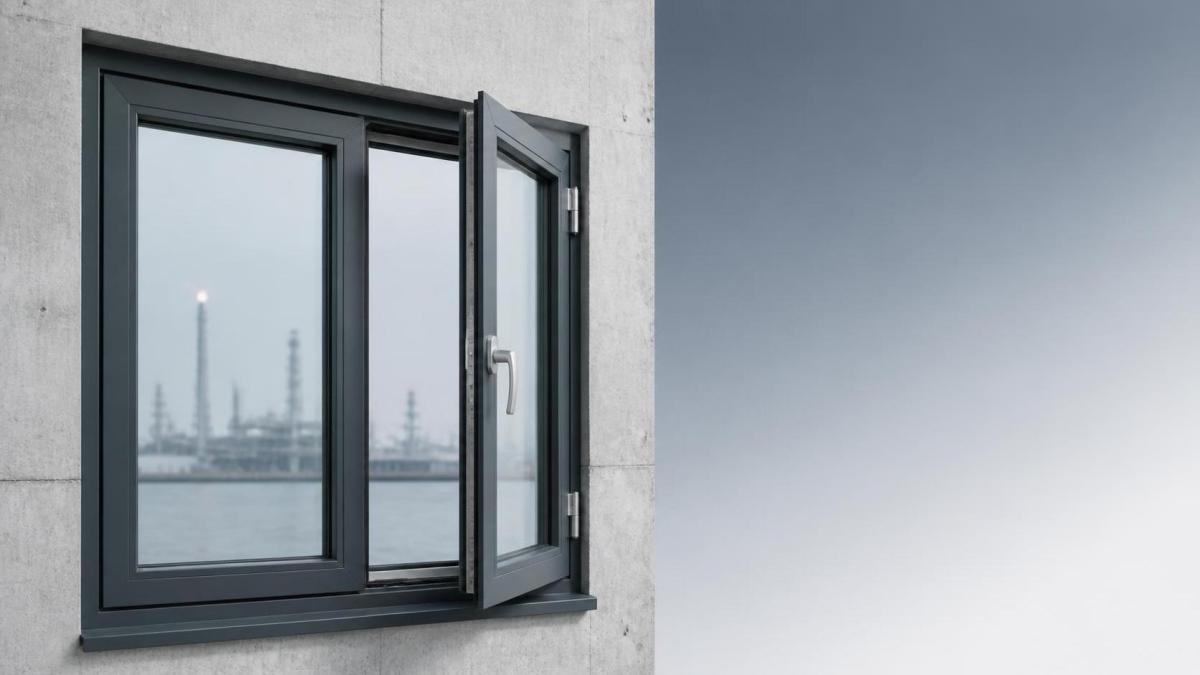
Why FRPU Frames Are Often the Better Balance
Pultruded FRPU window profiles combine continuous glass-fiber reinforcement with a polyurethane-based composite matrix. The pultrusion process produces consistent profile geometry and allows the structural reinforcement to run continuously along the length of the profile. For window construction, that matters because stiffness is built into the composite section rather than added later through a separate steel liner.
The absence of steel reinforcement is particularly relevant in acid-prone environments. It removes one common hidden corrosion point and helps create a more stable, non-metallic frame structure. FRPU frames also avoid the direct metal thermal bridge associated with conventional aluminum frames. In projects where air-conditioned interiors meet hot, humid, or chemically contaminated outdoor air, reducing conductive heat transfer can help lower the likelihood of surface condensation around the frame.
Another practical advantage is dimensional behavior. Composite FRPU profiles have a thermal-expansion characteristic closer to concrete wall construction than many metal alternatives. This does not eliminate the need for correct installation gaps and sealant design, but it can reduce stress caused by repeated temperature movement between the wall opening and the frame. In a factory building or coastal commercial property, that compatibility can make a difference over many seasons.
FRPU is also lightweight relative to its strength. That can be useful where windows must be transported to remote industrial sites, installed into curtain-wall-adjacent openings, or configured as larger operable units. Casement, sliding, tilt-and-turn, top-hung, hopper, fixed, louver, and bi-fold systems can all be developed around pultruded composite profiles, provided the opening size, glazing weight, and hardware loads are engineered as a complete assembly.
Do Not Judge the Frame in Isolation
A corrosion-resistant profile does not automatically create a corrosion-resistant window. This is where project teams sometimes lose the benefit of a good material decision. Hardware is usually the first item to require special attention. Hinges, friction stays, handles, screws, locking points, and installation brackets must be selected for the environment rather than chosen only for cost or appearance.
Glazing selection also affects long-term performance. Insulated glass may be appropriate where energy efficiency and indoor comfort are priorities. Low-E glass can support thermal control, while laminated tempered glass may be considered when safety, impact resistance, or security requirements apply. Yet glass selection should account for the actual pressure loads, thermal conditions, cleaning regime, and relevant local building requirements. A high-performance frame cannot compensate for unsuitable glass thickness or an improperly designed glazing system.
Gaskets and sealants deserve the same scrutiny. In an acidic environment, compatibility should be confirmed with the expected vapor, liquid contact, and cleaning chemicals. Even an otherwise durable assembly can leak if seals harden, swell, crack, or lose adhesion. There is no shortcut here: chemical compatibility information from sealant, gasket, coating, and hardware suppliers should be reviewed for the project’s actual exposure conditions.
Where Composite Frames Make Particular Sense
Chemical plants are the obvious application, but not the only one. Acidic exposure can occur in electrochemical workshops, metal treatment areas, storage buildings for corrosive materials, waste-processing facilities, agricultural processing sites, laboratories, and industrial buildings near exhaust discharge points. Coastal projects add another layer of complexity because salt spray and humidity can accelerate deterioration, particularly when industrial pollutants are also present.
FRPU frames can also be worth considering for passive houses, villas, hospitality buildings, and commercial projects in harsh climates. These projects may not face direct acid vapor, but they often need a window system that combines high insulation, UV-aging resistance, low maintenance, and reliable structural behavior. The same material characteristics that help in a chemical facility can be useful where heat loss, condensation, and coastal corrosion are persistent design concerns.
The best fit is usually a project where replacing failed windows would be disruptive or costly. A hard-to-reach façade elevation, an operating industrial building, or a project with stringent energy targets is rarely the place to optimize only for initial frame price. Lifecycle practicality matters more than the lowest bid on the day of purchase.
Questions to Settle Before Ordering
Before selecting an anti corrosion window frame for acid environment, the project team should define the exposure zone instead of using a single material specification everywhere. Windows directly facing a process discharge may need a different package from windows on a sheltered office façade.
- What acids or chemical contaminants may reach the window, and is the exposure vapor, splash, dust, or condensate?
- Will the frames be washed regularly, and which cleaning chemicals are used?
- Are there nearby marine conditions, high humidity, or strong UV exposure?
- What opening size, wind load, glazing weight, and operating frequency are expected?
- Which hardware materials, sealants, anchors, and glazing components are compatible with the project environment?
- Does the project require insulated glass, Low-E glass, laminated tempered glass, or another glazing configuration?
Custom dimensions and profile tooling can be useful when standard systems do not suit the wall build-up, opening geometry, façade appearance, or performance target. However, custom work should not be treated as a cosmetic exercise. It should resolve actual technical needs: drainage direction, glass rebate size, reinforcement strategy, connection details, thermal performance, and hardware integration.
The Practical Verdict
For mild exposure and straightforward openings, coated aluminum, stainless steel, or uPVC may still be appropriate when their limits are understood. But where acid-related corrosion, salt spray, thermal efficiency, and long service life overlap, FRPU/GFRPU composite frames often provide the most balanced solution. Their non-metallic structural design, corrosion resistance, low thermal conductivity, and stable behavior alongside concrete construction address several failure mechanisms at once.
The important qualifier is that the frame should be specified as part of a complete window system. Profile material, surface finish, insulated glazing, gaskets, hardware, fasteners, drainage, and installation all need to suit the exposure. A well-designed pultruded FRPU window can be a durable choice for chemical facilities and coastal construction alike, but the final selection should always be checked against the specific chemicals, operating conditions, and project requirements rather than a generic corrosion-resistance claim.