Are pultruded profiles stronger than extruded window frames? For demanding projects, the answer depends on structural design, material selection, reinforcement strategy, and expected long-term exposure.
Pultruded FRPU profiles combine continuous fiberglass reinforcement with polyurethane resin, creating insulated window frames that can carry significant loads without internal steel reinforcement.
Extruded frames can also perform well, especially in conventional residential applications, but buyers should compare complete system performance instead of relying on material labels alone.
What Is the Direct Strength Comparison?
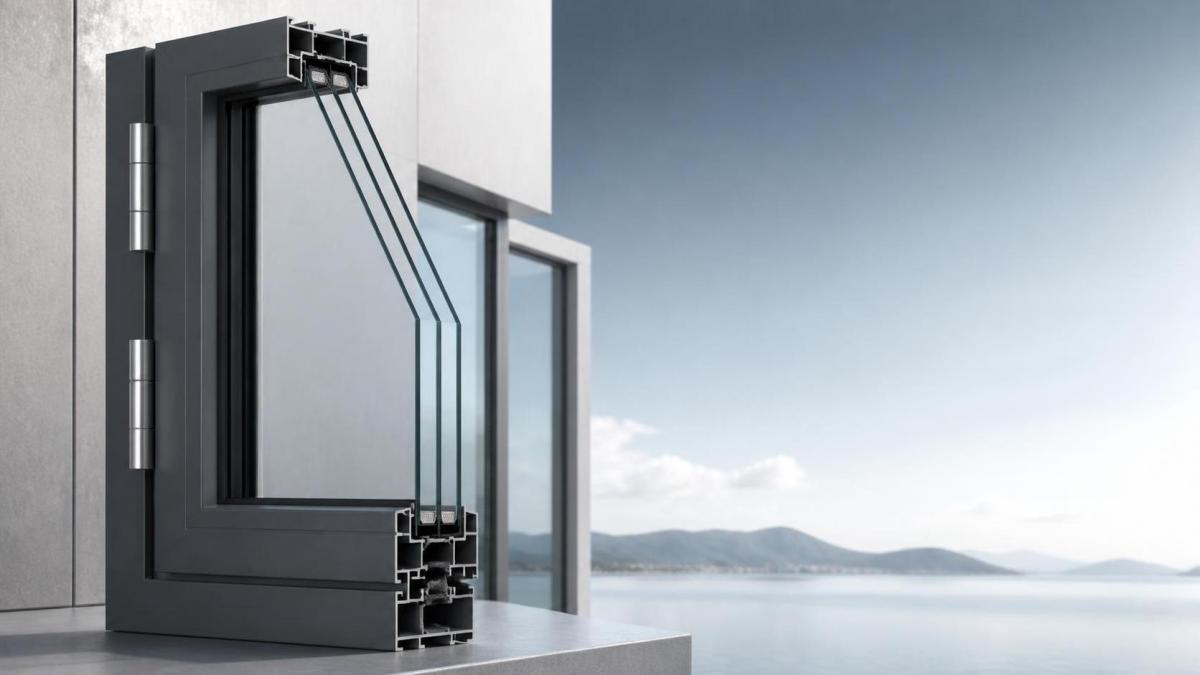
Pultruded FRPU profiles are generally stronger and stiffer than standard unreinforced extruded plastic window frames because continuous glass fibers run along the profile length.
Those continuous fibers efficiently resist bending, tensile loads, and frame distortion, which matters when windows use larger glass panels, wider openings, or heavy hardware.
However, a strong profile does not automatically create a strong finished window. Corner construction, glazing support, hardware fixation, and installation details remain equally important.
Extruded aluminum frames can offer high structural capacity, particularly with thicker wall sections or reinforced systems, but aluminum transfers heat rapidly without an effective thermal break.
Extruded PVC frames usually require steel reinforcement for larger units because PVC alone has lower stiffness and can deform under sustained loads or temperature changes.
FRPU profiles offer a different structural approach: the composite section itself provides reinforcement, reducing reliance on steel inserts and minimizing internal thermal bridges.
For projects asking whether pultruded profiles are stronger than extruded window frames, the relevant comparison should identify the exact extruded material, wall thickness, and reinforcement.
A properly engineered FRPU frame often exceeds unreinforced PVC in stiffness while offering better thermal insulation than conventional aluminum systems with limited thermal breaks.
The practical conclusion is straightforward: pultruded FRPU is usually a high-strength option, but final selection should rely on tested window-system data rather than generic claims.
Why Pultrusion Produces a Structurally Capable Profile
Pultrusion is a continuous manufacturing process in which fiberglass rovings, mats, and fabrics are pulled through resin and a heated forming die.
The process aligns much of the reinforcement in the direction where window profiles commonly experience bending and tensile forces during transportation, installation, and daily operation.
Unlike short-fiber materials, continuous fiberglass does not merely fill the resin. It forms a load-carrying internal skeleton throughout the profile cross-section.
Polyurethane resin binds the fiberglass reinforcement, protects it from environmental exposure, and contributes insulation, dimensional stability, and surface durability to the finished profile.
Profile geometry also matters. Multi-cavity designs, internal webs, glazing channels, and hardware zones can substantially influence the load-bearing behavior of an FRPU window frame.
Manufacturers can tailor fiber content, fiber orientation, wall thickness, and profile shape for specific window types, including casement, tilt-and-turn, fixed, and sliding systems.
This design flexibility is valuable when a project needs large openings but cannot accept excessive frame depth, visible steel reinforcement, or heavy metal sections.
Because pultrusion maintains a consistent process, well-controlled production can deliver repeatable profile dimensions, fiber distribution, and mechanical properties across long production runs.
Buyers should still request production controls, profile drawings, and test documentation, because different pultruded composites can vary considerably in quality and structural performance.
Which Strength Measurements Should Buyers Compare?
Do not compare window materials using a single strength number. A useful evaluation considers tensile strength, flexural strength, modulus, deflection, impact resistance, and connection performance.
Flexural strength indicates how much load a profile can withstand before failure, while flexural modulus indicates how resistant the profile is to bending.
For window frames, stiffness is often more important than ultimate strength because excessive deflection can affect air sealing, glass support, locking engagement, and appearance.
Tensile strength matters where hardware, anchors, mullion connections, or frame joints transfer forces through the profile during opening, closing, and wind loading.
Deflection testing under design wind pressure provides a more realistic indication of finished-window behavior than a material sample tested separately in a laboratory.
Ask suppliers whether performance data applies to the profile alone or to a complete window. Complete-system testing is more valuable for purchasing decisions.
For large operable sashes, also evaluate hinge capacity, screw pull-out resistance, locking-point support, and reinforcement around hardware mounting locations.
Glass weight can become a major structural factor. Triple glazing, laminated safety glass, and large insulated units require stronger sashes and reliable hardware interfaces.
In high-rise or exposed coastal projects, wind pressure calculations should reflect actual building height, orientation, opening size, local code requirements, and installation conditions.
A competent supplier should help translate project loads into profile selection, sash dimensions, glazing limits, reinforcement requirements, and verified window performance targets.
How Do Thermal Performance and Strength Work Together?
Structural capacity alone is not enough for modern windows. Buyers increasingly need frames that support large glazing while reducing heat loss, condensation risk, and energy demand.
FRPU profiles have low thermal conductivity because polyurethane and fiberglass are far less conductive than aluminum or internal steel reinforcement.
This helps reduce thermal bridging through the frame, especially around perimeter zones where indoor comfort and condensation control can be affected by cold exterior temperatures.
Steel-reinforced PVC systems may achieve useful structural capacity, but steel inserts can create thermal pathways that reduce the insulating value of the overall frame.
Aluminum thermal-break systems can provide excellent structural results, yet their final insulation performance depends heavily on thermal-break width, insulation inserts, and profile configuration.
FRPU can offer a favorable balance where projects need structural stability and low frame conductivity without combining several separate reinforcing and insulating components.
The thermal expansion coefficient of FRPU is relatively compatible with concrete construction, helping reduce stress caused by different material movements during temperature fluctuations.
This compatibility can be important for large façades, dark-colored frames, strongly exposed elevations, and projects located in regions with substantial seasonal temperature variation.
Lower temperature-related movement may help preserve seals, glazing clearances, drainage paths, and alignment over time, although correct installation gaps remain necessary.
For passive houses and energy-efficient developments, compare whole-window U-values, not only center-glass performance or frame material descriptions supplied in marketing literature.
Where Do FRPU Profiles Offer the Greatest Long-Term Value?
FRPU window systems are particularly relevant where corrosion, salt exposure, humidity, ultraviolet radiation, and maintenance costs create long-term risks for conventional frame materials.
Coastal buildings benefit from composite profiles because fiberglass-reinforced polyurethane does not corrode in the way untreated or poorly protected metal components can.
Chemical plants, laboratories, agricultural facilities, and industrial buildings may also value corrosion resistance where airborne chemicals or persistent moisture challenge traditional frames.
In humid climates, material stability can influence how reliably windows retain square geometry, compression sealing, drainage performance, and smooth operation over many years.
Lightweight profiles can simplify handling and installation, particularly for renovation projects, upper-level construction, remote sites, or areas with limited lifting equipment.
Lower maintenance needs should be assessed realistically. Surface finishing, sealants, glazing materials, hardware, and installation quality still determine service life and maintenance requirements.
UV-aging resistance is another important consideration for heavily exposed façades, where surface color retention and material durability influence the building's long-term visual quality.
For developers and owners, the value calculation should include energy savings, reduced corrosion risk, fewer replacements, lower maintenance, and improved occupant comfort.
The lowest initial frame price is not always the lowest ownership cost, especially when failures create disruption, water leakage claims, heating losses, or façade repairs.
FRPU systems can be especially compelling when a project needs a long service life and reliable performance in conditions that accelerate deterioration of less suitable materials.
When Are Extruded Window Frames Still a Sensible Choice?
Extruded frames remain appropriate for many projects, particularly when local supply chains, established fabrication capacity, cost constraints, and conventional opening sizes guide the specification.
Extruded aluminum is often preferred for very large commercial units, curtain wall interfaces, slim sightlines, and applications requiring exceptionally high structural capacity.
Its limitations are primarily thermal and corrosion-related, which can be addressed through advanced thermal breaks, coatings, careful detailing, and appropriate maintenance programs.
Extruded PVC can be cost-effective for standard residential windows where opening dimensions are moderate and required reinforcement can be integrated without compromising thermal targets.
For low-rise, sheltered buildings with small openings, a conventional extruded system may meet code and performance requirements at a lower initial investment.
The decision becomes more complex when windows become larger, glazing becomes heavier, climatic exposure becomes harsher, or energy performance requirements become more stringent.
At that point, steel reinforcement, deeper profiles, and added components can increase system complexity, weight, thermal bridging, manufacturing steps, and procurement dependency.
Rather than treating FRPU and extruded systems as universally competing products, buyers should define the specific performance problem their window package must solve.
Material selection is strongest when it follows project requirements for loads, climate, glazing, durability, energy codes, architecture, budget, and locally available technical support.
A qualified manufacturer should clearly explain where its system is suitable, where reinforcement is necessary, and where another frame technology may be more practical.
How Should Contractors and Distributors Evaluate an FRPU Supplier?
Start by reviewing the supplier's control over pultrusion, profile fabrication, glazing, hardware integration, and finished-window assembly. Fragmented responsibilities can complicate quality accountability.
Request profile cross-sections and identify the structural zones supporting glass, hinges, locking points, corner joints, drainage channels, and installation anchors.
Ask whether custom moulding is available when a project requires unique profile depth, sightline, color, glazing thickness, drainage design, or regional hardware compatibility.
Verify supported glazing options, including insulated glass, Low-E glass, laminated tempered glass, and triple glazing, because glass selection directly affects frame and sash loads.
Review test reports for air permeability, water tightness, wind-pressure resistance, thermal transmittance, acoustic performance, impact resistance, and operational cycling where applicable.
Clarify the applicable standards before requesting data. Test methods and classifications differ by market, and reports should match the intended project location and approval requirements.
For OEM and ODM procurement, confirm drawings, color samples, tolerances, packaging methods, production lead times, spare-part availability, and technical communication procedures.
Inspect sample windows whenever possible. Evaluate corner accuracy, surface finish, gasket continuity, drainage details, sash operation, lock engagement, and visual consistency under normal light.
Final Decision: Is FRPU the Better Structural Choice?
Pultruded FRPU profiles are generally stronger and stiffer than ordinary unreinforced extruded plastic window frames, while providing insulation advantages unavailable from standard metal construction.
They are not automatically superior in every project, because very large commercial openings, local fabrication practices, budget constraints, and tested system configurations influence the right choice.
The best question is not simply whether pultruded profiles are stronger than extruded window frames, but whether the complete window meets the required structural and thermal targets.
For coastal, energy-efficient, corrosive, temperature-variable, and long-life building applications, FRPU can offer a highly practical balance of strength, insulation, durability, and reduced thermal bridging.
Specify the finished system using verified performance data, project-specific load calculations, appropriate glazing, and capable installation details to obtain reliable results throughout the window's service life.