FRPU
window
Pultruded FRP fiberglass window with polyurethane resin matrix. No steel liner, excellent thermal insulation, salt‑corrosion & weather resistance. Fit for passive house, coastal and high‑rise projects, customizable casement & sliding styles.。
Choosing corrosion resistant windows for chemical plant buildings is less about finding a frame that simply “does not rust” and more about matching the entire window system to the exposure it will face. Acidic vapor, alkaline dust, salt-laden air, washdown moisture, UV exposure, and repeated temperature changes can all shorten window service life. In many industrial buildings, the frame, hardware, sealants, glazing edges, and wall connection fail at different rates. The right window is the one that keeps those weak points under control.
For highly corrosive locations, non-metallic composite frames such as FRPU/GFRPU are often worth serious consideration. They avoid the basic oxidation problem associated with exposed steel and aluminum, while also offering low thermal conductivity and good dimensional stability. That does not mean every chemical plant needs the same solution. The process area, building location, cleaning routine, ventilation design, and required window operation all matter.
A practical answer is this: fixed or limited-opening composite windows with corrosion-resistant hardware and properly specified glazing are usually the most dependable choice for buildings close to chemical processing, storage, wastewater treatment, or coastal exposure. Aluminum, uPVC, and steel windows can still be suitable in less aggressive areas, but only when their coatings, drainage, hardware, and maintenance plan are appropriate for the actual environment.
Why Chemical Plant Windows Fail Earlier Than Expected
Many window failures begin quietly. A frame may look acceptable from a distance while corrosion is developing around screws, hinges, drainage paths, glazing beads, or the connection between the frame and the concrete wall. By the time staining, flaking coating, difficult operation, or water leakage becomes visible, replacement may be the only practical option.
Chemical plants create a more complicated exposure profile than ordinary commercial buildings. A window on an administration block may mainly see rain and sunlight. A window on a packaging hall, tank farm control room, laboratory perimeter, or wastewater building may face chemical mist, humid air, occasional splash, or residue carried by exhaust airflow. Even two elevations of the same building can age differently when prevailing wind directs emissions toward one side.
Material selection should therefore begin with the exposure zone, not with a preferred frame material. Ask what reaches the window surface, how often it happens, whether deposits are washed away, and whether the building has temperature swings that can stress joints and seals.
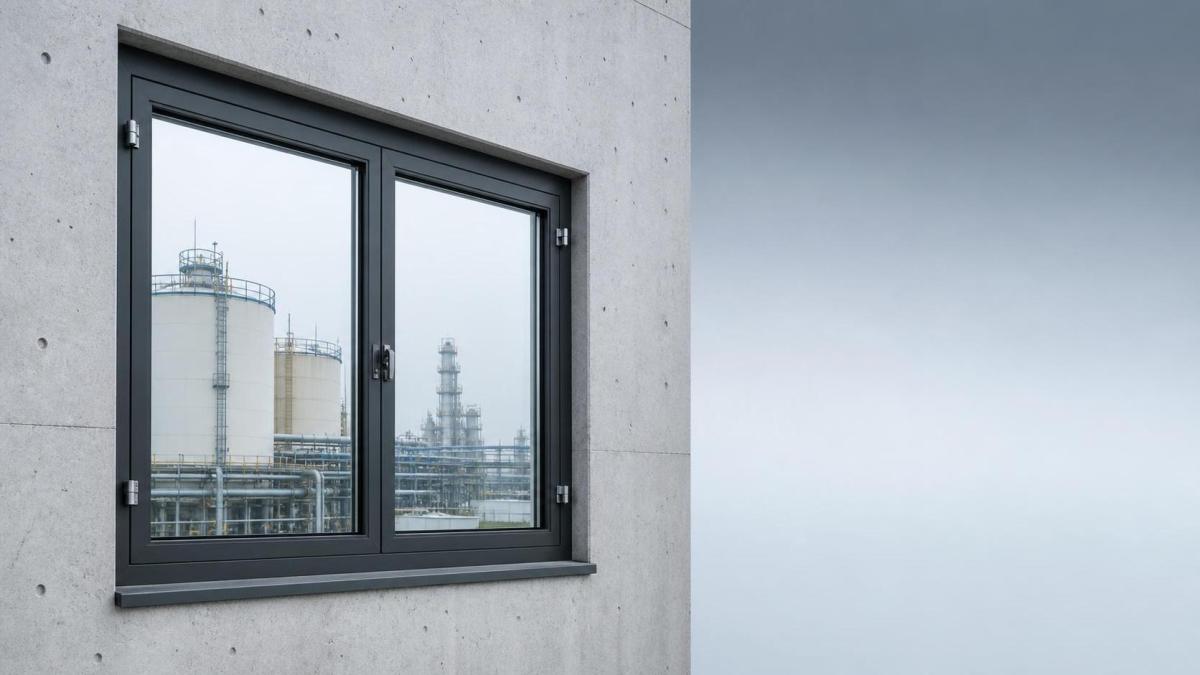
Comparing Corrosion Resistant Windows for Chemical Plant Buildings
There is no universal “best” window material. Each common option has a place, but the limits need to be understood before it is specified for a corrosive industrial site.
Aluminum is often selected because it is familiar, widely available, and structurally capable. In a mild environment, a good powder-coated aluminum window can serve well. The problem is that a coating is a protective layer, not a guarantee. Scratches, cut ends, drain holes, hardware interfaces, and areas where water sits are more vulnerable. Salt deposits and chemical residue can make these details more consequential.
uPVC is naturally non-rusting and can be economical, especially for smaller utility buildings. Yet chemical plant projects should not treat it as automatically suitable. Large openings, strong wind loads, hot façades, and frequent temperature changes can demand more stiffness and better dimensional control than a standard uPVC system provides. Reinforcement may also introduce metal components that need their own corrosion assessment.
Steel frames have obvious strength advantages, and correctly selected stainless steel can be appropriate for specialist applications. But “stainless” does not mean immune to every industrial atmosphere. Grade selection, weld finishing, drainage, crevice avoidance, and cleaning all influence real performance. In some corrosive locations, the maintenance burden can be higher than expected.
Where FRPU Composite Windows Make the Most Sense
Fiberglass-reinforced polyurethane window profiles are particularly useful when corrosion resistance and thermal performance need to work together. The frame is a non-metal composite, so there is no metal thermal bridge through the profile itself and no need for steel reinforcement inside the profile. This helps reduce heat transfer through the frame while removing a common hidden corrosion concern found in reinforced window constructions.
FRPU profiles also have a thermal expansion behavior closer to concrete than many conventional window materials. That can be useful where an industrial façade sees substantial day-to-night temperature changes. Movement is never eliminated, and installation joints still need proper design, but closer movement characteristics can reduce stress on perimeter seals and fixings over time.
These systems are a sensible fit for chemical plants near the coast, fertilizer or chlor-alkali facilities, industrial wastewater buildings, battery-material processing sites, and production areas with persistent humidity. They can also be appropriate for control rooms and laboratories where energy performance matters alongside material durability.
The case is weaker where the building is remote from chemical exposure, windows are small, indoor conditions are dry, and the project is driven entirely by the lowest initial purchase cost. A conventional window may be adequate there. Paying for a high-performance composite system makes more sense when it avoids future access work, disruption, repeated coating repairs, or premature replacement.
The Frame Is Only One Part of the Corrosion Decision
A common mistake is to choose a corrosion-resistant frame and then overlook the components attached to it. In actual projects, hardware and installation details often determine whether the window remains reliable.
Start with the window function. Fixed windows have fewer moving parts and are generally the lowest-risk choice for heavily exposed walls. Where ventilation is required, top-hung, hopper, casement, tilt-and-turn, sliding, or louver configurations should be selected based on the ventilation requirement and the contaminant path. A window should not be relied upon as the main ventilation strategy for a process area where controlled mechanical ventilation is required.
For operable windows, ask the supplier what hardware materials and finishes are available. Hinges, handles, friction stays, rollers, fasteners, restrictors, and locking points must be compatible with the environment. Corrosion-resistant hardware should not be an afterthought added after the frame has been selected. Hardware must also remain accessible for inspection and replacement.
Glazing deserves equal attention. Insulated glass can improve thermal performance in conditioned rooms. Low-E glass may be appropriate where solar control or reduced heat loss is needed. Laminated tempered glass can be considered when safety, impact resistance, or glass retention is part of the project requirement. The glazing specification should be based on wind load, thermal conditions, safety needs, and any relevant project standard. It should not be chosen solely because it is the most expensive option.
Finally, examine the perimeter. Sealants, packers, anchors, flashings, and shims need chemical compatibility and proper drainage. Water trapped at the sill can carry contaminants into joints. A well-made frame cannot compensate for a poor installation detail that allows residues to collect behind the cladding or within the opening.
Questions to Ask Before Specifying a Window System
Procurement teams often receive broad statements such as “corrosion-proof” or “industrial-grade.” Those descriptions are not enough for a chemical plant building. Ask for a project-specific conversation around exposure and configuration.
- What chemicals, vapors, dusts, or washdown agents may reach the external and internal window surfaces?
- Is the site coastal, and are salt deposits likely to remain on the façade?
- Which elevations face exhaust outlets, cooling towers, loading areas, or prevailing winds?
- Are windows mainly for daylight, emergency visibility, occasional ventilation, or routine operation?
- What hardware, fasteners, sealants, and glazing accessories are included in the proposed system?
- How will sill drainage work, and can the window be inspected and cleaned safely after installation?
- Does the supplier have a profile and fabrication process that can be customized for the required dimensions, color, opening type, and glazing build-up?
These questions help separate a suitable system from a generic building window with an industrial label. They also help the manufacturer identify where standard details need adjustment. Custom profile moulding, window dimensions, surface colors, and glazing options can be valuable, but customization should follow exposure assessment rather than appearance alone.
Do Not Overlook Maintenance and Access
Low maintenance is not the same as no maintenance. Composite frames can reduce concerns associated with metal corrosion, but any exterior window still collects dirt, airborne contaminants, and deposits around drainage points. Regular visual checks should look for blocked weep paths, damaged seals, stiff hardware, cracked glass, failed perimeter sealant, and changes in how the sash closes.
Cleaning methods matter. A strong cleaner chosen for the plant floor may not be suitable for window gaskets, coatings, hardware finishes, or glazing seals. The facility team should follow the window supplier’s cleaning guidance and confirm compatibility before introducing a new chemical cleaning routine. Abrasive pads and aggressive tools can create damage that later becomes a corrosion or water-entry point on metal components.
There is also a planning issue that gets missed: can the window be safely reached for cleaning and repair? On high façades, inside process enclosures, or above equipment, access can cost far more than the replacement part. That is one reason a durable, well-specified frame and limited-operable configuration can be financially sensible even when the initial price is higher.
FAQ
Are aluminum windows suitable for chemical plant buildings?
They can be suitable in lower-exposure areas, particularly offices and control spaces separated from process emissions. Their coating system, hardware, drainage, and installation details should still be evaluated. For direct, frequent, or highly corrosive exposure, a non-metal composite frame may provide a more dependable long-term approach.
Do FRPU windows need steel reinforcement?
FRPU window profiles can be engineered without steel reinforcement. This avoids a hidden metal element inside the frame and supports the profile’s thermal performance. The required window size, wind load, opening style, and glazing weight should still be reviewed during design.
Which window type is best for a highly exposed chemical process area?
Fixed windows are often the simplest and lowest-maintenance choice because they eliminate hinges, rollers, and other moving components. Where opening windows are necessary, use a configuration with hardware specified for the exposure and make sure ventilation needs are addressed by the overall building design.
Does corrosion resistance solve condensation problems?
No. A corrosion-resistant frame can help avoid frame degradation, but condensation depends on indoor humidity, surface temperature, ventilation, glazing performance, and thermal bridging around the opening. The full wall-to-window detail needs to be considered.
Make the Choice Based on Exposure, Not Habit
The most reliable corrosion resistant windows for chemical plant buildings are specified from the actual exposure conditions outward. Compare materials honestly, then check the full system: frame, reinforcement, hardware, glass, seals, drainage, anchors, and maintenance access.
For projects where chemical vapor, humidity, salt spray, UV exposure, and thermal movement are genuine concerns, FRPU/GFRPU composite window systems offer a practical non-metal alternative. Their corrosion resistance, low thermal conductivity, light weight, and high strength can support a longer-lasting industrial building envelope when paired with suitable glazing, compatible hardware, and careful installation. The final specification should always be confirmed against the site’s chemicals, operating conditions, building code requirements, and façade design.