FRPU
window
Pultruded FRP fiberglass window with polyurethane resin matrix. No steel liner, excellent thermal insulation, salt‑corrosion & weather resistance. Fit for passive house, coastal and high‑rise projects, customizable casement & sliding styles.。
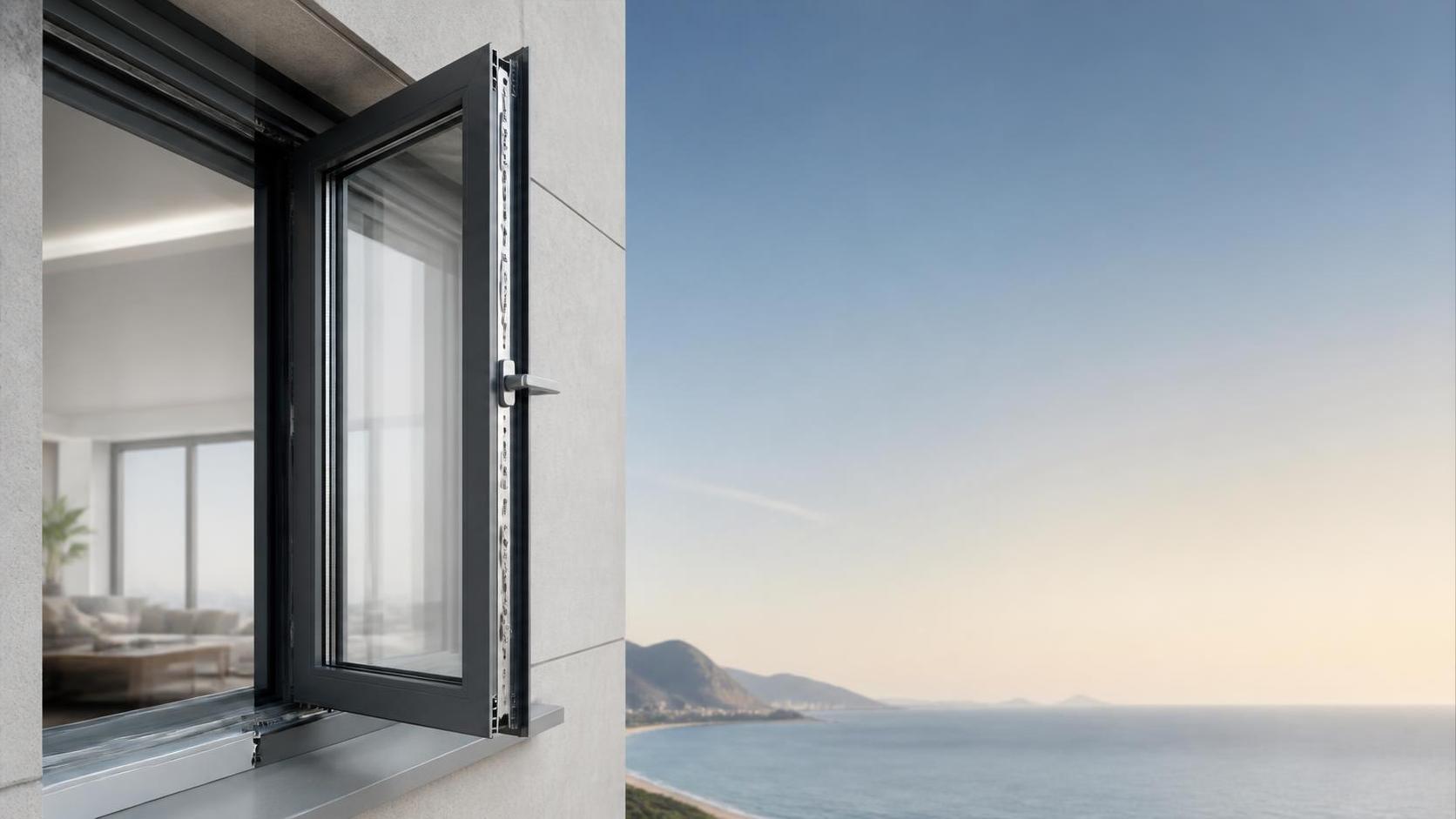
FRP window GRP window)
Fiberglass window
Fiberglass reinforced polymer window
Pultruded fiberglass window
What Are FRPU Casement Windows?
FRPU Casement Windows are side-hinged window systems made with pultruded fiberglass-reinforced polyurethane profiles. The sash opens inward or outward around vertical hinges, creating a wide, controllable opening for ventilation, cleaning, and emergency egress planning where required. FRPU refers to a composite material in which continuous fiberglass reinforcement is integrated with polyurethane resin through a controlled pultrusion process. The result is a structural profile designed to support glazing, hardware, weather seals, and repeated opening cycles.
Unlike conventional metal-reinforced vinyl frames, FRPU profile systems can be designed without internal steel reinforcement. This helps reduce conductive thermal paths within the frame while preserving dimensional stability. A finished casement window normally includes an outer frame, opening sash, insulated or safety glazing, gaskets, hinges, handles, locking points, drainage paths, and perimeter sealing components. Final performance depends on the system design and the compatibility of these components, not on the profile material alone.
For specification purposes, buyers should distinguish between the FRPU profile and the complete window assembly. Profile properties influence insulation, stiffness, corrosion behavior, and machinability. Complete-window performance also depends on glass configuration, sash dimensions, hardware load capacity, installation method, wall interface, and project testing requirements. This distinction is important when comparing quotations or preparing technical schedules for residential, commercial, industrial, and coastal construction.
How The FRPU Profile System Works
Pultrusion is a continuous manufacturing method in which reinforcing fibers are drawn through resin impregnation and a heated forming die. For FRPU Casement Windows, this process creates profiles with repeatable cross-sections that can incorporate chambers, glazing rebates, gasket grooves, hardware fixing zones, and assembly features. The polyurethane matrix binds the reinforcement, while the fiberglass contributes tensile strength and resistance to shape change under normal service conditions.
The low thermal conductivity of composite framing supports the thermal envelope of a building, particularly when paired with insulated glass or Low-E glass. Because the frame does not rely on steel reinforcement, the system can reduce a common internal thermal bridge found in some reinforced window constructions. However, overall U-value, condensation resistance, and energy performance should be confirmed for the exact window size, glass build-up, spacer, opening configuration, and installation condition.
A casement system also relies on compression sealing. When the sash is closed and multi-point hardware engages, gaskets are compressed around the perimeter to help limit uncontrolled air and water entry. Proper sash alignment, corner assembly, drainage design, and hardware adjustment are therefore essential. A high-quality profile cannot compensate for incorrect fabrication or installation, which is why project buyers should evaluate the supplier's manufacturing controls together with the material specification.
Main Types And Configurations
Single-sash casement windows are the most direct configuration: one operable sash is hinged on either the left or right side. They suit bedrooms, kitchens, villas, and smaller facade openings where simple operation and effective perimeter compression are priorities. For larger openings, paired casements can use a fixed mullion or a floating mullion arrangement, subject to local code requirements, hardware limits, and wind-load calculations.
FRPU Casement Windows can also be combined with fixed lights, transoms, side lights, top-hung awning sections, or tilt-and-turn elements. Fixed sections increase daylight and visible area without adding hardware complexity, while operable sections provide ventilation where it is needed. In project schedules, each element should be identified separately because fixed and opening units have different glass loading, drainage, sealing, and performance considerations.
Glazing choices commonly include double insulated glass, Low-E energy-saving glass, and laminated tempered safety glass. Selection should respond to climate, solar exposure, acoustic targets, safety requirements, and local building rules. Security screens, insect screens, child-restrictor options, and multi-point locking systems can be coordinated with the opening direction. Buyers should request a clear drawing showing handing, viewing direction, hinge side, handle position, glass specification, color, and accessory scope before production begins.
Why Choose FRPU For Demanding Projects
FRPU Casement Windows are relevant where buyers need a balance of insulation, structural stability, long-term weathering performance, and corrosion resistance. Composite profiles do not have the same rust mechanism as unprotected steel components, making them practical candidates for salt-spray exposure, humid climates, and certain corrosive industrial environments. Their value is strongest when the complete system is specified with suitable hardware, glazing, seals, fixings, and installation materials.
Compared with frame systems that include conductive metal reinforcement, a zero-metal thermal bridge profile concept can support lower heat transfer through the framing path. This can be useful in passive-house-oriented and low-energy building projects, where designers pay close attention to junction details and whole-window thermal performance. It does not remove the need to assess glazing edges, wall connections, shading, air leakage, or moisture management within the wider building envelope.
AnHui Te Chuang manufactures pultruded FRPU/GFRPU profiles and finished system windows within an integrated production process. For buyers, this can simplify responsibility across profile production, precision processing, window assembly, and technical coordination. The company offers casement systems alongside sliding, bi-fold, tilt-and-turn, awning, hopper, fixed, and adjustable louver window options, allowing a project to maintain a coordinated material approach across multiple facade opening types.
Who Uses Them And Where They Fit
Typical users include window distributors, facade contractors, house builders, architects, developers, and procurement teams sourcing windows for villas, residential communities, hospitality properties, commercial stores, and industrial facilities. Casement windows are especially useful where occupants value direct ventilation control and where the opening can be positioned to capture prevailing breezes. For export buyers, the required opening direction and egress function must be confirmed against the destination market's building regulations.
Coastal buildings are a key application because salt-laden air can accelerate corrosion of vulnerable components. In these projects, frame material is only one part of the solution: hinges, fasteners, handles, screens, anchors, and exterior sealants must also be selected for the exposure category. FRPU systems can support a corrosion-conscious specification, while robust drainage, compatible flashing, and routine cleaning help protect the complete installation over its service life.
AnHui Te Chuang reports supplying global markets including Europe, America, Southeast Asia, and Oceania. Its passive-house and ultra-low-energy villa project support in Europe and North America has centered on casement, tilt-and-turn, and fixed window combinations with a zero-metal thermal bridge concept. For chemical plant projects in the Middle East and Southeast Asia, the company has supplied configurations such as louver, hopper, and sealed casement windows to address ventilation, dust control, and corrosion-related operating conditions.
Selection Criteria And Quality Control
Start selection with project conditions rather than a generic profile request. Record opening sizes, building height, design wind pressure, exposure to rain and salt, indoor humidity, required thermal target, acoustic objective, safety glazing needs, and local code requirements. These inputs determine sash limits, glass thickness, hardware grade, gasket arrangement, reinforcement strategy where applicable, and installation details. Request a formal technical submittal that links each proposed configuration to these project conditions.
Key evaluation documents may include profile cross-sections, fabrication drawings, glass specifications, hardware schedules, color samples, packaging details, installation guidance, inspection records, and relevant test reports available for the proposed system. Industry performance discussions generally cover air tightness, water tightness, resistance to wind load, thermal performance, acoustic behavior, operational durability, and safety. Buyers should confirm which test method, specimen size, and configuration apply rather than assuming a result applies to every size or variation.
AnHui Te Chuang describes full-process inspection from incoming raw materials through pultrusion, in-process monitoring, air and water tightness checks, wind-load checks, and final product inspection. For OEM or ODM work, early approval of drawings, samples, colors, glazing, and packaging reduces production uncertainty. The company can support custom profile moulding, non-standard dimensions, custom colors, and glazing solutions, while CAD assistance and remote technical guidance can help align the delivered product with site requirements.
Installation, Maintenance, And Future Trends
Installation should preserve the window's designed drainage and sealing paths. Installers need to check the opening for plumb, level, structural adequacy, and compatible substrate conditions before fixing the frame. Shims should transfer loads without distorting the frame, and perimeter joints need appropriate backing material, sealant selection, and weatherproofing details. After glazing and sash installation, verify smooth operation, even gasket compression, locking engagement, drainage outlet clearance, and protection of finished surfaces.
Maintenance requirements are generally straightforward but should be scheduled. Building operators should clean frame and drainage areas, inspect seals for damage or compression loss, check hardware fasteners, lubricate moving hardware according to the hardware supplier's guidance, and confirm that sash alignment remains correct. In marine or industrial exposure zones, more frequent cleaning and inspection are prudent because deposited contaminants can affect glass, hardware, sealants, and adjacent construction materials even when the FRPU profile itself resists corrosion.
Industry demand is moving toward lower operational energy use, better envelope continuity, larger glazed areas, durable materials for harsh climates, and more configurable project solutions. This increases interest in thermally efficient composite window systems, high-performance glazing, improved sealing, and digitally managed fabrication documentation. Future-ready procurement should retain flexibility for upgraded glass, hardware, solar-control needs, and regional compliance requirements instead of treating the frame alone as the complete performance solution.
Total Cost Of Ownership And Procurement Planning
The purchase price of FRPU Casement Windows is only one part of total cost of ownership. Buyers should account for engineering, mould development where custom profiles are needed, glazing, hardware, screens, surface finish, packing, export logistics, import duties, installation labor, sealants, maintenance, replacement access, and potential energy-related operating effects. A low initial quote may not be comparable if it excludes hardware grade, glass type, project drawings, testing support, spare parts, or protective packaging.
A practical ROI review compares like-for-like window assemblies over the intended service period. Consider the cost implications of thermal performance, corrosion exposure, air leakage risk, maintenance intervals, site rework, and expected replacement frequency. For large projects, specify mock-up approval, production tolerances, inspection hold points, batch traceability, shipment labeling, and a spare hardware policy. These controls can reduce avoidable variation and make receiving inspection more efficient at destination.
For an actionable sourcing package, provide AnHui Te Chuang with elevations, opening schedules, wall build-ups, climate and exposure information, required performance criteria, target quantities, delivery destination, and preferred glazing or hardware requirements. The supplier can then develop a configuration and commercial scope that makes assumptions visible before ordering. This approach gives distributors and project contractors a clearer basis for comparing FRPU Casement Windows across performance, customization, lead time, logistics, and long-term project value.